
AI Infrastructure Data Centers
Data Centers are booming in numbers these days. Apple, Google, Alphabet, Meta, Microsoft and many other high-tech companies are the builders and owners of these Data Centers. The expert team of engineers that work there combine technical insight, hands-on support, and global reach to deliver to customers —on time, on spec, and built to last. By connecting cables, data centers connect people, ideas, and innovation – laying the groundwork for a more resilient, sustainable energy future.
In Telecommunication sector: Data Centers support everything from legacy copper systems to next-gen fiber networks. This service spans global rollouts, regional deployments, and local last-mile solutions. Meaning, a telecom provider that’s building from the core or expanding to the edge, data centers work alongside to that specific project to design, deploy, and sustain critical infrastructure with confidence.
In Energy Sector: Data Centers build connections that keep energy flowing – from underground infrastructure to above-ground innovation. In a world of evolving demands, shifting regulations, and growing sustainability goals, connection means more than just physical infrastructure – it’s about trust, local expertise, and the ability to scale smartly and sustainably. That’s exactly what Data Centers deliver.
Here on Earth, the vast data centers that power artificial intelligence swallow huge amounts of energy. Tech companies are building massive numbers of AI data centers, with more than 4,000 are in operation across USA now. These vast data centers that house thousands of servers and can stretch over a million square feet and have mostly been built within the last decade. Communities living near these Data Centers expressed their concerns about the environmental and financial implications of such facilities in their backyards.
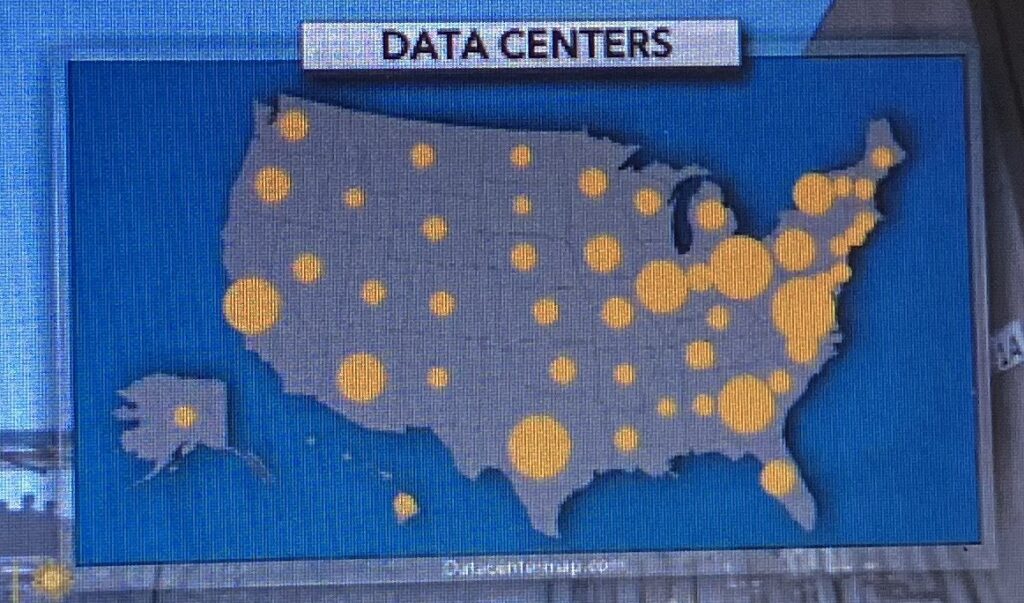
Popped-up DATA CENTERS tentative locations – Across USA
There are two global problems these Data Centers are worsening. First, burning gas and coal is still heating up the planet. Second, data Centers consume enormous amount of power. Thousands of these AI data centers that popped up all over the country consume enormous amounts of power, which produces even more carbon pollution – and drives up our electric bills.
According to Andrea Marinoni, associate professor with the Earth Observation group at the University of Cambridge, an author of the study found that these Data Centers release heat through their energy-intensive processes, including computation and powering cooling systems. Marinoni’s research group studied 20 years of remote sensors and found surface temperatures of the area increased by an average of 3.6 degrees Fahrenheit after a data center started operations. In extreme cases, nearby temperatures increase by up to 16.4 degrees Fahrenheit. Case in point – Mexico’s Bajio region, which has become a data center hub.
Andrea M.’s paper which has not been peer-reviewed yet. (See Reference at the bottom)
OpenAI says it’s using over a million GPUs. By count, 1 million GPUs already require enough energy to power a small city. Scaling that to 100 million could demand more than 75 gigawatts of power costing an estimated $3 trillion in hardware alone. On top of that cost is needed for its maintenance, cooling and expansion process. Here is a real-world scenario: Unlike OpenAI and Anthropic, Musk’s AI-based startup xAI has decided to train and power its efforts by choosing to build and run its own infrastructure. xAI’s goal is to build a huge amount of high-end AI hardware. Its Colossus supercomputer alone, is estimated to run on around 200,000 Nvidia H100 GPUs, drawing anywhere between 50 and 150 MW of power from a system supplemented with methane-burning gas turbines. Its use of natural gas-burning turbines to power data centers in and around Memphis, Tennessee. The turbines emit smog-forming pollutants and particulate matter that can lead to increased health risks and an unpleasant odor, among other things.
Pollution from the turbines, which xAI has used in Memphis, Tennessee, for its Colossus 1 and Colossus 2 data centers, has been a major source of local contention for more than a year.
To STOP, we are still at the beginning of this demand. Increased pressure from environmental and civil rights groups over pollution concerns are litigating in court now.
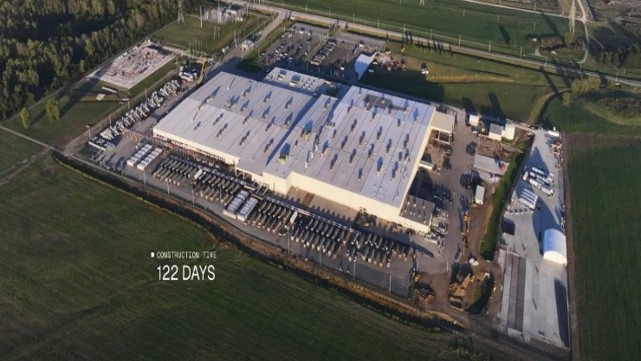
COLOSSUS – World’s Biggest Supercomputer
DESCRIPTION: The world’s biggest supercomputer, Colossus. Built in 122 days—outpacing every estimate—it was the most powerful AI training system yet. Then Musk and his team doubled it in 92 days to 200k GPUs.
Number of GPUs — 200KGPUs
Total Memory Bandwidth -194 Petabytes/s
Network Bandwidth per Server – 3.6 Terabits/s
Storage Capacity – >1Exabyte
The xAI company’s use of dozens of natural gas-burning turbines requires a federal permit. The company’s violation of the Clean Air Act causing harm nearby communities.
END of Message
https://shorturl.fm/1DKAk