
How Claude Works
Dear ‘fbsolarllc’s’ Readers & Visitors: After a rigorous search to know more about Anthropic’s work ethics and policies; I think I have found the best suited article to that goal. This article enlisted and pointed out the terms and policies very clearly for how Claude in Anthropic works. The article’s name is Tom’s Guide, and it is available online. The link I’ve provided below as well. With minor adjustments I copied the article entirely and presented here for all the relevant person’s benefit. Keep in mind that ANTHROPIC currently is the leader of AI.
*Copied EXACTLY from the Link: ANTHROPIC
The Name Claude originated from a person’s name Claude Shannon. Mr. Claude was recognized as the father of information theory in 1948). Anthropic’s Claude chatbot is designed to be:
- Helpful for summarizing documents, coding, writing, and research
- Honest by explaining limitations and avoiding misleading or false answers
- Harmless, serious in avoiding unethical or dangerous content generation
How does Claude work?
At its core, Claude is a large language model (LLM) trained on massive datasets. But Claude follows “Constitutional AI” system — the approach is novel guiding Claude’s behavior based on a written set of ethical principles, rather than human thumbs-up/down ( ) during fine-tuning.
Claude runs on the latest version of Anthropic’s model family (the current is Claude 4.8 Opus), and it’s packed with standout features:
- Constitutional AI framework. Instead of relying on hidden human feedback, Claude evaluates its own responses against a “constitution” — a list of rules like Don’t generate harmful advice or Explain reasoning clearly. Almost as built-in AI values.
- Massive context window. Claude can handle up to 200,000 tokens of input — roughly 150,000 words — meaning it can analyze full books, codebases, or long email threads without losing context.
- Extended Thinking Mode. Claude 3.7 Sonnet introduces a hybrid reasoning model that allows users to choose between rapid responses and more thoughtful, step-by-step reasoning. This model integrates both capabilities into a single framework, eliminating the need for multiple models. Users can control how long the model “thinks” about a question, balancing speed and accuracy based on their needs.
- Artifact creation. Claude can create standalone artifacts for code, documents, diagrams and other structured content during conversations. This makes it easier to collaborate on creative writing, programming projects or technical documentation without covering the chat interface. These Artifacts can be published and shared with other users or kept private.
Cowork is a new agent-style way to work with Claude that extends beyond coding. Built on the same foundations as Claude Code, Cowork lets Claude take on real work tasks with more autonomy—like a digital coworker—rather than just responding in a chat.
ACTIVITIES: Instead of a standard conversation, Cowork gives Claude explicit access to a folder on your computer. Within that folder, Claude can:
- Read, create, edit, rename, and organize files
- Turn screenshots into spreadsheets
- Compile notes into reports
- Reorganize downloads or documents automatically
Claude plans tasks, executes them step-by-step, and keeps the user informed as it works—similar to how Claude Code operates, but designed for non-technical workflows.
What’s different about Claude Cowork is that it gives users more agency: Claude can plan and complete multi-step tasks independently, without repeated context-giving or format conversion. Users can also queue tasks and give feedback while Claude keeps working.
Power features:
- Works with existing connectors to pull in external information
- New built-in skills for documents, presentations, and files
- Can pair with Claude in Chrome to handle browser-based tasks
Context window: Up to 1 million tokens
One of Claude’s standout features is its massive context window. Most users get around 200,000 tokens by default — that’s equivalent to about 500 pages of text — but in certain enterprise or specialized use cases, Claude can handle up to 1 million tokens. This is especially useful for summarizing research papers, analyzing long transcripts or comparing entire books.
Now that Claude includes vision capabilities, this huge context window becomes even more powerful. Claude can analyze images, graphs, screenshots and charts, making it an excellent assistant for tasks like data visualization, UI/UX feedback, and even document layout review.
CONCLUSION:
Anthropic’s Claude family has become one of the most talked-about alternatives to ChatGPT and Gemini.
Whether a user is looking for a fast, lightweight assistant or a model that can deeply analyze documents, code or images, there’s a Claude model that fits the bill.
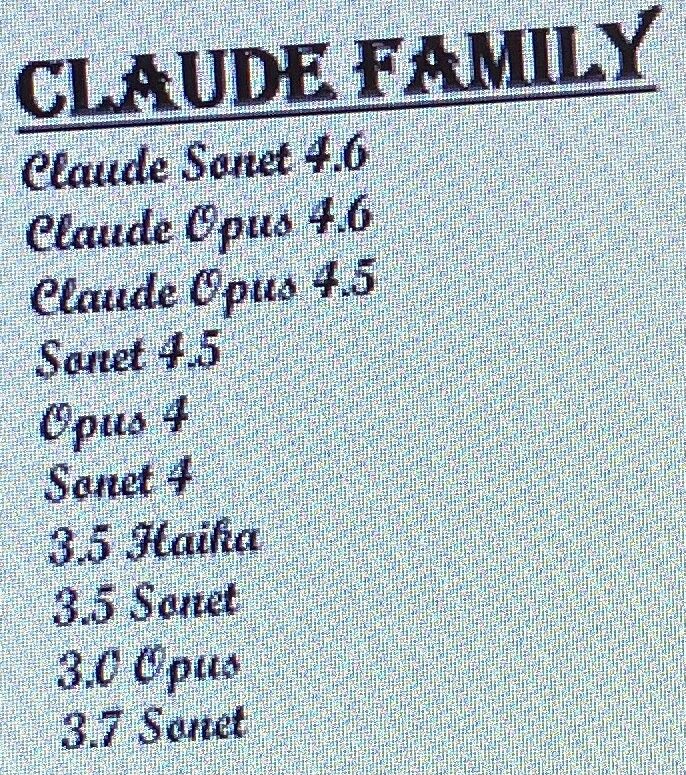
CLAUDE FAMILY
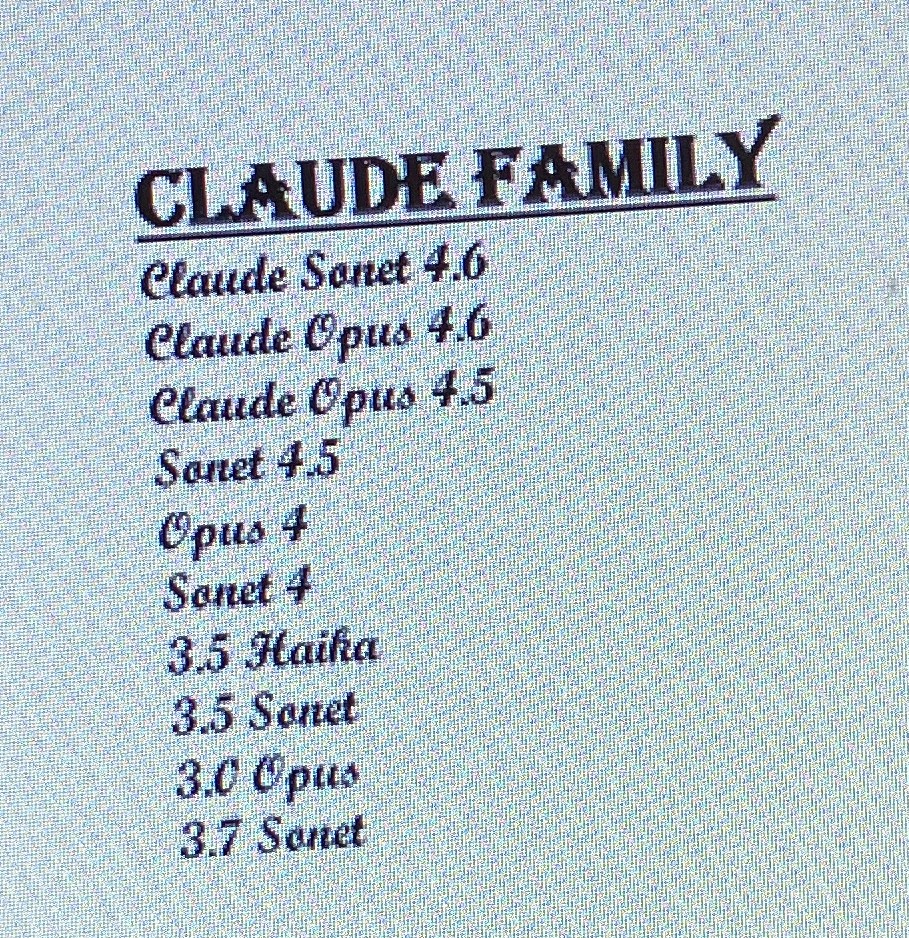
While Opus focuses on frontier-level complexity, Sonnet 4.6 is optimized for real-world decision support, communication and structured problem solving — the kinds of tasks people actually face daily. It combines thoughtful reasoning with consistent tone control and practical judgment, making it especially effective for collaborative work, planning and situations that require nuance rather than raw computational depth.
REFERENCE:
ANTHROPIC
Features By: Alex Hughes, Amanda Caswell, Feb 19, 2026
2. https://www.tomsguide.com/ai/best-chatgpt-alternatives
3. https://www.tomsguide.com/ai/google-gemini/google-gemini-everything-you-need-to-know
END OF ENTRY