
How Data Centers Work
(From a Mechanical and Electrical Viewpoint)
Note, Blog’s Title I’ve used – DATA CENTER: PART II.
My last posting was on ‘DATA CENTERS’ – my impression at the time was everyone is familiar somewhat to AI technology. Noup! Not true entirely. This realization came to me after considering some raw comments from some commentators (may be they are Ghost visitors). That doesn’t matter. I’ve decided here to reintroduce Data Center for general public, this time — dug out from scratch.
Beginners Questions are:
What a data center does,
Why do these facilities consume so much energy and
Why mechanical and electrical systems are the most critical part of the Data Center?
Every email sent or received, every video streamed and watched, and every file we worked on is stored in the cloud existing somewhere physically is our ‘Internet.’ To Tech people internet is a network of buildings filled with servers, electrical infrastructure and cooling systems that work continuously to keep data flowing. These buildings are actual Data Centers. In this Blogpost I focused on the systems that keep servers powered, cooled and facilitated to make sure that systems operate with no interruption.
At its simplest level, a data center is a facility designed to store, process and distribute digital information. [Information is a vital parameter as those in the natural world such as mass, charge, or energy. In the most basic sense, information is any kind of description that can be reduced to a simple string of zeros (0) and ones (1) — known as binary digits, or bits. Meaning information can be quantified and manipulated in a digital computer.] Ref. 1
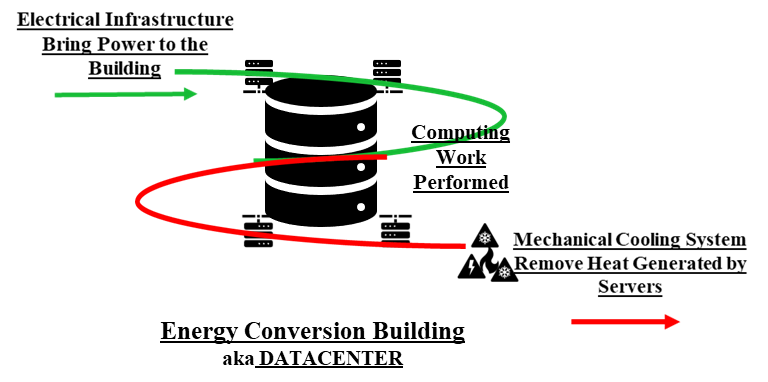
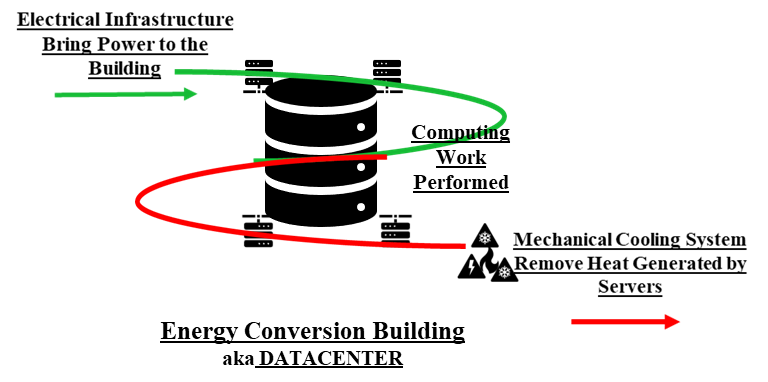
Inside the data centers building there are rows of servers, which are specialized computers responsible for storage, computing and network traffic. Servers operate continuously, they run 24 hrs. a day, every day of the year. This creates an important reality. Servers consume large amounts of electricity, and nearly all of that electrical energy eventually becomes heat. While most people think of data centers as IT facilities, from an engineering perspective they are really energy conversion buildings. Electricity goes in, computing work is performed, and heat comes out. The entire facility exists to manage this process safely and reliably.
Every data center (regardless of size) must enact 3 fundamental tasks:
- Make ascertain continuous power source,
- Determines Continuous cooling,
- Operate nonstop,
Demand for Continuous Operation is the reason why Servers cannot simply shut down in absence of power. Even brief interruptions of power can cause ‘data loss’ or service outages affect thousands of millions of users. As a result, power systems must remain available even when equipment fails or utility power is interrupted. Servers generate heat continuously; therefore, cooling system also must be in action mode incessantly as well. If cooling stops for any reason, Temperature rise quickly forcing equipment to reduce performance or shutdown to protect itself. Cooling a Data system is not about comfort; it is about equipment survival.
Data Centers are designed for availability. Maintenance and equipment failures and repairs must occur without interrupting operation. This requirement is what drives the heavy use of redundancy throughout both mechanical and electrical systems.
Data centers infrastructures falls into 3 major system groups:
- Electrical systems or electrical infrastructure bring Power to the building and distribute it safely to the server equipment (this includes utility, connections, switch gear, backup and power distribution).
- Mechanical Cooling System (remove heat generated by servers; (include chillers, pumps, air handling units).
- Controls and Monitoring (Electrical and mechanical system units together into one operating unit).
summary: Under constant Electrical loads, cooling demands operate continuously, with no break time at all is the Data Centers that we all dependent on.
Futuristics:
Elon Musk is an AI expert who opined that ‘computing demands from AI will quickly outstrip what we can provide here on Earth. A “terawatt-scale annual AI compute growth,” will require power to match. That’s a stunning figure. All the world’s data centers use around 40 gigawatts today.’ Musk predicted that world would need an additional terawatt worth of compute every year.
To encounter the issue, Musk has started considering big server racks in space. powered by 24/7 sunshine. In reality, all the Silicon Valley executives have become obsessed with space-based solar power. Based on an estimate from SpaceX “space-based solar arrays can generate “more than five-times the energy” of terrestrial ones thanks to 24/7 illumination.”
REFERENCES:
- Reference 1: Robert M. Hazen and Michael L. Wong; “Time’s Second Arrow,” W.W. Norton & Company Inc. New York, NY 10110
- Reference 2. msn news.com Date Published: (5/24/26).